Friday, June 3, 2011
The Coup
In December of 1990 Vladimir Kryuchkov began preparing the KGB for a Soviet Union "state of emergency", hoping that he could convince Gorbachev to call a state of emergency and "restore peace" within the Soviet Union. On July 29, 1991 Gorbachev, Yeltsen, and Nazarbayev met to talk about replacing conservative with more liberal minds. Kryuchkov had put surveillance on Gorbachev, and was not pleased. On August 18 they gave Gorbachev an ultimatum, either declare a state of emergency or resign and let the vice president take over. Gorbachev refused and he was locked in his vacation location in Foros. After the return the conspirators declared a state of emergency and Gennady Yanayev took place as acting president due to Gorbachev's "illness". They band all papers excluding 9 communist based one. Eventually Gorbachev came back into power and the conspirators were arrested. Y

Friday, May 13, 2011
America and the welcoming of the Shah
It is a common practice to say that hindsight is 20/20; however, there are those times when you wonder what people were thinking. One such situation is the White House decision to let the Shah back into the country. The American Revolution was against a king, and we created a government form to be sure that a monarchy never prevails in America again. It is odd that we easily forget our own anger at our tyrant when it comes to another county. Before letting the Shah into the country the US and Iran were already on thin ice with one another, and whoever thought that letting the Shah into America was not thinking of how it would look to the Iranian people. It was not impossible that America was preparing to force the Shah back into government, it was certainly not beneath us. It was dangerous to do something so stupid when there were Americans, with little defense, in the country we were insulting. It also allowed for the more radical govenrment to step in. I understand that he needed treatment, and that we were once allies, but there are ways to get around that. We should have found a way to treat him outside the U.S, because that would have been safer for the Americans at the embassy. It may have also lead to a less radical government and a better relationship between the U.S. and Iran.
Thursday, April 21, 2011
The Great Leap Forward
The Great Leap forward was one of the greatest tragedies in history. 20-30 million people died during the program, which was originally aimed at industrialization through communes (commune dining hall). The idea of the commune was almost utopian. Each commune contained about 5000 families. Once in the commune everything that used to be owned by the individual was now owned by the commune as a whole, including their work. The commune assured that all adults could work by providing school and a nursery for all of the children, and the elderly were moved into "houses of happiness" and provided healthcare. By 1958 700 million people had been placed into 26,578 communes, a feat only possible through skillful propaganda(a card celebrating the Great Leap Forward). However, by 1959 things began to go downhill. The communes were held to impossible standards, and complaining meant you were a bourgeoisie reactionary. The homemade steel and shoddily put together machines were fall apart when used, and caused injury. Also, because the peasants were working on their "back-yard productions" they didn't harvest the desperately needed food but party members would not tell Mao the real numbers in fear of being accused of being a bourgeoisie sympathizer, so the people suffered. Perhaps the real issue with the great Leap forward was that Chairman Mao was unapproachable. Could such a noble movement have been saved if the leader had actually known what was happening. In the respect it is Mao's fault for creating a government where he can't even get accurate statistics. Maybe he would have changed the course of The Great Leap Forward if he knew that instead of making and exceeding their quota the communes were slipping into a state of disrepair and famine.


Thursday, April 7, 2011
Proof
After facing discrimination in South Africa Mahatma Gandhi vowed to create justice through non-violence. He developed the concept satygraha he kept to it, never wavering, even when others pressured him to. It is strange, when looking at the Indian revolution that there was so much bloodshed in the end. It makes it difficult to believe that a concept such as peaceful protest could ever work. However, one of Gandhi’s campaign was truly able to show the power of peaceful protest, and that is the salt march.
For people who live in hot climates salt is very important. Gandhi exclaimed his choice by saying the following, “Next to air and water, salt is perhaps the greatest necessity of life. It is the only condiment of the poor….There is no article like salt outside water by taxing which the state can reach even the starving millions, the sick, the maimed and the utterly helpless. The tax constitutes therefore the most inhuman poll tax that ingenuity of man can devise” ( Dalton 100). Salt is so important because when people sweat they lose salt in their bodies, because people sweat more in hot climates they need more salt to replace what they have lost. Everyone in India was affected, and although people were skeptical Gandhi was correct in his analysis; the march would be for everyone, not just for the wealthy and not just for the poor.
The salt march was the epitome of a peaceful protest, it was merely a mass of people collecting what nature gave them. There was little to no violence performed by the Indians. After a little while the British police began to act. Webb Miller, a journalist who was present at the time, wrote of the tragedies he saw during the March (scroll to paragraph 6). Gandhi had invited many journalists around the world to watch the Salt March, this linked with the non-violent Indians is what really caused the India Acts. Gandhi let the world see the Indians doing nothing but collecting salt from the ocean, it was made obvious that the Indiana did not want to hurt the British, they just wanted to be free from them. This was in contrast to the British, who were beating the unprotected protestors. Because of this the English look horrible to the rest of the world. The only way to set this straight was to grant India some freedom. If Gandhi had not enforced peace then the world could have seen the Indians as violent, and then the British would look justified in their treatment of them. This is why the salt mach is the greatest case for peaceful protest, because without it the March would have been a bust.
Thursday, February 10, 2011
Rasputin and Alexandra
“Nicholas II had a romantic vision of him leading his army. Therefore, he spent much time at the Eastern Front” (http://www.historylearningsite.co.uk/russia_and_world_war_one.htm). Nicholas’s departure was detrimental to the Romanov family because Nicholas’s absence left the Tsarina, Alexandra, in charge.
Alexandra’s control had many different nuances and none of them were good. Alexandra had 5 children, 4 girls and 1 boy whose name was Alexis. As the Tsarina Alexandra’s first, and most important, job had been accomplished; she had provided a seemingly healthy male heir. However, things took a turn for the worse when Alexis was found to have hemophilia, a disease that prevents blood from clotting. The royal doctors were unable to help him, which is when she turned to Rasputin, a self proclaimed holy man who was rumored to be able to cure people. Neither Rasputin nor Alexandra liked the Duma, Alexandra was a firm believer in the autocracy and Rasputin knew that if the Duma gained too much power his position in society would take a hit. As long as Alexis was sick Rasputin would have control over the Tsarina, who, in turn, had control over her husband (last paragraph).
World War I also aroused the Russian population’s suspicions as to where Alexandra’s loyalties were. In her husbands absence she quickly fired many ministers and replaced them with other, less capable people, hired essentially Yes Men to Rasputin. The population quickly came to the conclusion that Alexandra was a German spy, hell-bent on destroying Russia. Alexandra and Rasputin’s rule was a huge factor in the Tsar’s abdication and eventual execution.
Monday, January 10, 2011
Solutions
There are many things that the industrial revolution is known for, between revolutionizing inventions like the steam engine and the new norm of gender segregation, the industrial revolution has much to offer. A major questions when looking at the industrial revolution is, "Did it end up benefiting people?". Along with the all the new innovations came a spotlight on problems that already existed, which lead to a large movement to solve them, making the world a better place.
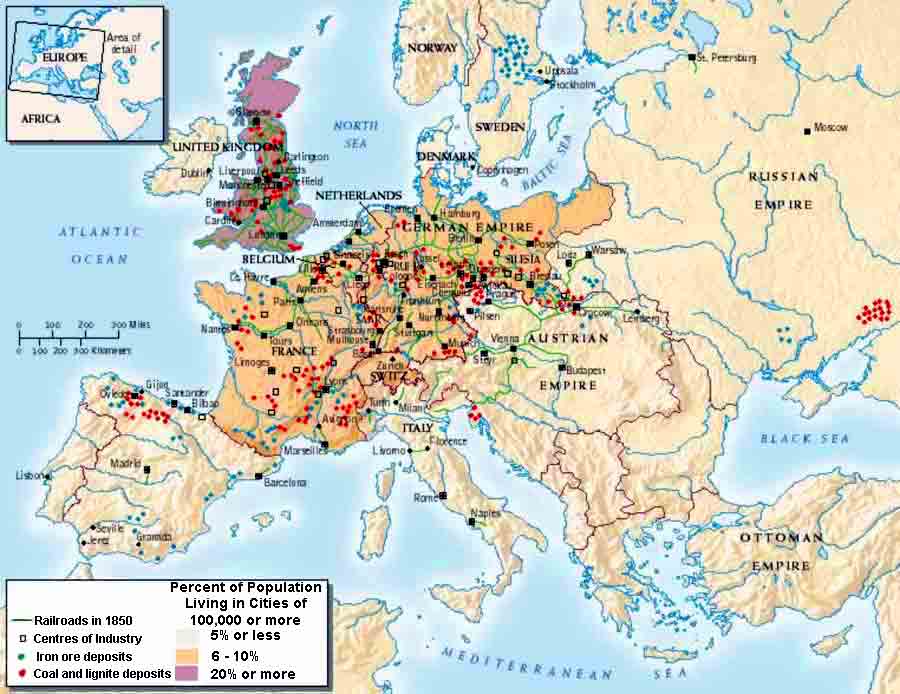
The industrial revolution, first and foremost, affect the sheer density of the population in cities. As you can see in this map, the population living in cities was outrageous. The cities were not built to hold the amount of people they had to, and as factories began moving to the cities they got more and more crowded. The second large issue was cleanliness, or lack there of. Children would play in mud and people would drink water form the rivers that factories dumped their waste into. Going hand-in-hand with cleanliness was disease. The crowded cities were breeding grounds for diseases like cholera, typhoid, and typhus. At the time no one knew what caused such diseases, let alone cure them, so the epidemics wreaked havoc on the crowded, dirty cities. The final missing item in these cities were public transportation. Without public transportation workers had to stay condensed in the central city areas, enhancing the other problems even more.
For the first time it became crucial for solution to be found. Through this we received urban planning, the germ theory, vaccines, public transportation, and general cleanliness. Although many blame the industrial revolution for causing all the problems they were there before, the industrial revolution merely shined a light on them. This gave way to solutions. It seems that humans become most proactive when the situation is dire. Perhaps we will have another "revolution" of solutions as our fossil fuel slowly runs out and an alternative is needed.
The industrial revolution, first and foremost, affect the sheer density of the population in cities. As you can see in this map, the population living in cities was outrageous. The cities were not built to hold the amount of people they had to, and as factories began moving to the cities they got more and more crowded. The second large issue was cleanliness, or lack there of. Children would play in mud and people would drink water form the rivers that factories dumped their waste into. Going hand-in-hand with cleanliness was disease. The crowded cities were breeding grounds for diseases like cholera, typhoid, and typhus. At the time no one knew what caused such diseases, let alone cure them, so the epidemics wreaked havoc on the crowded, dirty cities. The final missing item in these cities were public transportation. Without public transportation workers had to stay condensed in the central city areas, enhancing the other problems even more.

For the first time it became crucial for solution to be found. Through this we received urban planning, the germ theory, vaccines, public transportation, and general cleanliness. Although many blame the industrial revolution for causing all the problems they were there before, the industrial revolution merely shined a light on them. This gave way to solutions. It seems that humans become most proactive when the situation is dire. Perhaps we will have another "revolution" of solutions as our fossil fuel slowly runs out and an alternative is needed.

Subscribe to:
Posts (Atom)