It is true that in our study of the French Revolution we have seen ideology and the cause it supports weakened by contradiction. From the men of Mountain quickly turning on one another after they cried for fraternity to Napoleon turning back the clock on many reforms that occurred during the Revolution, the leaders of these political upheavals spoke of new directions but their actions brought them in line with the policies they fought to overturn. The Haitian Revolution was no different in this respect. Toussaint L'Ouverture, freed slave and leader of the Haitian Revolution, had his own contradiction. It was Toussaint that lead the struggle against slavery and French domination, rallying the enslaved of Saint-Domingue with the lure of freedom and self-rule. After all the plantations had been burned, the oppressors driven out and the western provenance of Saint-Domingue, which was essentially independent, it came time to figure out how to govern the country and to re-build Haiti's economy. Before the revolution, Saint-Domingue was incredibly wealthy, relying on the free work of slaves to harvest sugar cane and coffee. Sugar cane, in particular, was a valuable crop and Haiti had become the main source for this lucrative good. Recognizing the financial potential in sugar cane, Toussaint L'Ouverture reasoned that if he could restore the sugar trade, Saint-Domingue's economy would once again thrive and its people prosper. However, the former slaves did not want to go back and work like they had for so many years, they wanted to be free and this meant making the choices that had been denied them for so many years. Many wished to live a simple life where they grew food for themselves. In the eyes of Toussaint, such a lifestyle could not bring the economic and political strength that came with financial prosperity, and soon the "former" slaves were forced to go back into the cane fields and harvest the sugar. Toussaint L'Ouverture hoped and believed that a stable economy would bring peace to the island, however he did not take into account the long term repercussions of his actions and the ensuing political fallout.
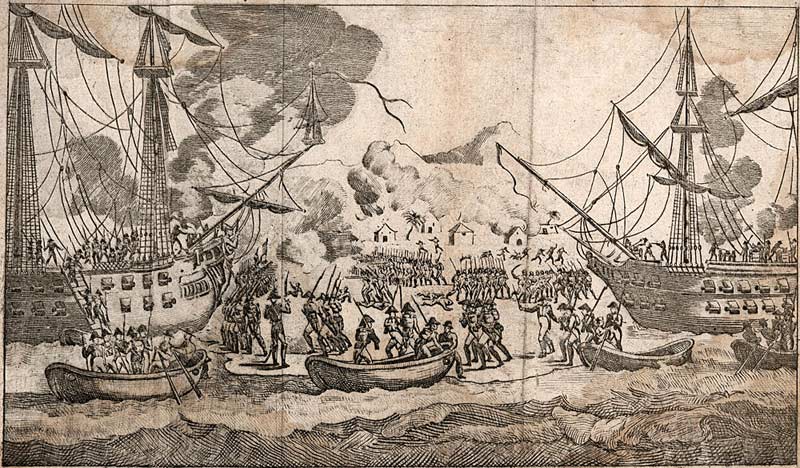
In 1802, France sent a large fleet which anchored in the Haitian port. For three months Toussaint attempted to fight the French army, but the original enthusiasm for the cause, itself anchored in the push to throw off the shackles of slavery, had been lost with the forced return to the cane fields. The people realized that the change they were originally promised was not going to happen. The Haitian Nationalism, much like the French Nationalism, that had inspired the slaves to revolt against the tyranny of an unjust system, began to decline, disillusionment replacing ardor. How important was Haitian Nationalism? When looking at the events after L'Ouverture's imprisonment, it is clear that the Haitian people had the ability to defeat the French when they believed their freedom could be gained. But the sacrifices made had to carry with them the promise of change. Without that change, there was no reason to carry on the cause. Had L'Ouverture found a different way to stabilize the economy, he may have been there to see his country finally free.
Friday, December 10, 2010



Thursday, November 11, 2010
Could it have lasted?
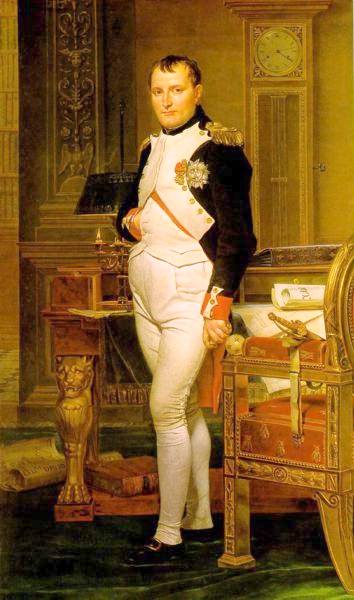
With the Napoleonic Era on the horizon an imminent question hangs in the air: was the French revolution successful? That is not the question I’m going to answer today; however, I would like to look at the structure that the French government tried to maintain throughout the revolution.
The most prominent man elected to the French government was Maximilien Robespierre. Robespierre was credited with the Reign of Terror, where anyone suspected of treason was thrown into prison or sent to the “revolutionary razor”, coincidently his life was ended by the very same contraption. The French’s “democratic” government seemed to fall apart after Robespierre’s death. Why was America able to create a truly democratic government and France was not? The reasons are innumerable; while America was fighting against another nation France was fighting against itself, the American way of thinking was not as violent and radical as France’s, and, perhaps because they were the first to revolt America was more tentative in it’s ideas. It seems that the way France’s government was created lent itself to needing a strong leader, like Robespierre. Although this is the opposite of a democracy France’s ideals about freedom were a little skewed any way (Robespierre’s murder of men who spoke out against him seems like a blatant disregard for freedom of speech), the moment Robespierre was gone things began to go down hill.

France’s success was built around two emotions: spirit and fear. Both of these feelings are unpredictable and can easily become wildly out of control. For an entire nation to go around hyping each other up about revolutionary ideas was a ticking time bomb, one that Robespierre kept it under control with an iron fist. This form of government, which is dependent on a strong leader cannot last, as shown by the French Revolution. This situation is deja vous from when Louis XV died and was replaced by his son who said, “ What I should like most is to be loved”. Louis XVI was weak and the result of that was the fall of the French monarchy. My question is what do you think keeps governments that depend on a strong leader running when a weak leader is in power? With it’s government structure was there any way that the French revolutionary government could have continued? What changes would have had to be made for the government to last?
Personally, I think that governments like monarchies are held firmly in place by a few things. The first is previous leaders, if there had been a few strong leaders before the weak one people may be willing to hold on to a government that has worked in the past. The second is precedent; although this was shaken when people began to revolt I think that the tradition of a government form keeps the people faithful as well. The third aid is a secondary lawmaking body like Parliament, which can support a weak monarch and instill hope within the people. I think the high emotion the French people were running on was bound to come back and bite them; eventually, fear and spirit are no way to run an effective government. I think that if the French government wanted to continue on it’s trajectory to democracy and freedom that they would have had to make some serious reforms, like America did to the Articles of Confederation. They hadn’t spent much time thinking about how, functionally, the government would really work, making it strong leader dependent. And that is where Napoleon comes in.
Wednesday, October 20, 2010
What the treatment of the Native Americans meant

Throughout our study of the Revolutionary War we have seen the idea, "It's the principle of the matter" put into effect. The colonists, although opposed against British taxes, were more opposed to what the taxes symbolized. With each new act the colonists could see Parliament's control over them which, to the colonists, was unacceptable. So they fought a war and founded a new country, and a new system of government, on the basis that, "All men are created equal", a principle that is far from true. When looking at the hypocrisy of this statement the inclination is to immediately travel to the south, where slavery was a way of life, the pinnacle of the delicate precipice that the south's economy stood upon. In no way am I discrediting the slaves' struggles and the horrid practice that was the slave trade, however, I do feel that it is important to shift focus to another group that was wronged by the Americas, the Native Americans.
Before going into the wrongdoings of the Americans, I would like to review 3 of the complaints that the colonists had against Britain prior to the war. The first was the colonists' representation in Parliament. The colonists complained that they did not have a say in what happened to them, because there was no colonist representative in Parliament. Parliament countered that because they wanted what was best for the British Empire as a whole, that America would benefit. This is what Britain called virtual representation, and to the colonists, it was not fair. The second large grievance was the colonist's ability to rule their own provinces. When the Townshend Acts were passed the colonists were outraged because the governors, who used to be under the thumb of the colonial assemblies because they voted on their salaries, would now be paid by Britain, which would lead the governess to listening to the crown instead of to the colonial assemblies. The colonists believed that they had the right to rule themselves, tax themselves, and generally do their own thing, and that is was ludicrous for Britain to suggest anything else. Finally, the Coercive Acts were followed by the Quebec Acts. Although the Quebec Acts had to do with French provinces it also granted political rights to members of the Roman Catholic church, as well as recognize the roman catholic church from a legal standpoint in the new province. Although this does not seem like a problem, the paranoid Americans were sure that the Crown was merely trying to get them all under the rule of the Pope.
Now we return to the new American government, the government of "equal men", unless, you weren't a white landowning male of an appropriate age, then this did not apply to you. Under this unfortunate category fell the Native Americans, a people who lived in America before the European countries even knew it existed. However, after all of Colonists' grievances with England the Americans didn't seem to think it was wrong to do that same to the Native Americans. Although the Native Americans lived in America they had no representation in America's government. This seems very similar to the colonies' representation in the British Parliament, however, the Native Americans did not even receive the benefit, if it can be called a benefit, of virtual representation. The native Americans lived in a nation inside of a nation. The constitution had not addressed who had sovereignty over what. Although the American government sometimes agreed with the idea that the Native Americans had sovereignty over their own land, because it was not not the Constitution it lead to the Native Americans being manipulated by the Americans (as shown in the depiction of Manifest Destiny which appears above). The American would soon begin to push Christianity on the Native Americans, a much more drastic approach than that of Britain's so called, "Papal takeover". In Major Problems in American History, on page 191 a Native American, Chief Red Jacket, exclaims what America has taken from them. He said, "You have got our country, but are not satisfied; you want to force your religion upon us". Although this speech is about 20 years after the ratification of the constitution, 20 years is not a lot when it comes to the ripple affect of history.
It is strange to think about America taking away others' rights when they are so pompous about their own. The situation of the Native Americans is different from that of the of the African Americans, for not everyone considered them inferior, in fact, George Washington believed that it was not the Native Americans who were inferior, just their way of life. Like in when you developer film, it seems the actual intentions of the Americans blacken as more and more light is shed upon them. Just like in a Saturday Night Live skit featuring Tina Fay as Sarah Palin and Amy Pohler as Hillary Clinton , Hillary states, " I didn't want a woman to be president, I wanted to be president and I just happen to be a woman" (this part starts at 3:21 but you can watch the whole thing, it's funny). The colonies cry of freedom and equality for all seems like a cover up for their own selfish desire to be free of some taxes, for how can a country who claims they only want equality treat the vast majority of the people living in it like trash.
Tuesday, October 5, 2010
Lexington and Concord
The battle at Lexington and Concord was not as intense of a battle as people may think because of it's significance. Although it must have been thrilling for the colonists to have lost less men than the British, that is not what was important. Before America's conflict with England each area was it's own unit. There was not much unity, other than the fact that they were all under English rule. Lexington and Concord was the British's reaction to America's unification. The Continental Congress had recently agreed on a variety of propositions that varied from sending a letter of grievances to the King to stopping trade with Britain all together. When Paul Revere signaled that, "The regulars are coming out!", 60 to 70 minute men were ready to fight. Lexington and Concord was the accumulation of America's efforts to fight the crown, as one unified nation.
The original order for attacking Lexington and Concord were made up of two components, the desire to capture Sam Adams and John Hancock and to capture the illegal gunpowder in Concord. However, when I look at both of these causes I do not think they were the main drive behind the British's attack. Although they may have wanted it to seem like they were retrieving illegal items and capturing two rebels, I believe that the British had had enough of America and were looking for a reason to fight. They had every right to believe that they could easily beat the Americans, whose troops were groups of ragtag men without any professional military training, so why no put the Americans back in their place? Do you think that Lexington and Concord was merely and retrieval mission, or something more?



The original order for attacking Lexington and Concord were made up of two components, the desire to capture Sam Adams and John Hancock and to capture the illegal gunpowder in Concord. However, when I look at both of these causes I do not think they were the main drive behind the British's attack. Although they may have wanted it to seem like they were retrieving illegal items and capturing two rebels, I believe that the British had had enough of America and were looking for a reason to fight. They had every right to believe that they could easily beat the Americans, whose troops were groups of ragtag men without any professional military training, so why no put the Americans back in their place? Do you think that Lexington and Concord was merely and retrieval mission, or something more?

Tuesday, September 14, 2010
Interesting stuff about Bertolt Brecht's Galileo
Today I went to see Dr. Korfhage with questions about last night's reading, along with some general questions about the difference between Bertolt Brecht's Galileo and Mckay's Galileo. Bertolt Brecht was a German playwright born in 1898. Brecht was a communist and a dramatist who believed that plays should make you think. Brecht thought that if a character was like-able then the audience would begin to stop thinking about the meaning of the play itself, blinded by their fondness for the character. Brecht purposely made his Galileo a greedy, stubborn, and rude man, a person the audience would not sympathize with. When his Galileo and the Galileo from McKay are compared, there are no obvious traces of Galileo's personality that matches Brecht's character's demeanor. Thank you Dr. Korfhage for shedding some light on the two Galileos.


Subscribe to:
Posts (Atom)